Prioritise Water and Environment matters in your plans, stakeholders urged

The eighth Uganda Water and Environment Week (UWEWK) is ongoing with a call on stakeholders to prioritise water and environment issues in their plans for mitigating environment degradation and in building resilience to survive climate change. Africa Innovations Institute is actively participating in the events running under the theme:” Water and Environment resources for enhanced resilience and improved incomes and livelihoods”.
Africa Innovations Institute is a not for profit, non-governmental centre for excellence in agricultural innovations established in 2005. Officiating at the ceremony, the Minister in charge of General Duties in the Office of the Prime Minister, Rt. Hon. Justine Kasule Lumumba called for collaboration between government, non-government /Civil Society organisations, academia and the private sector, to ensure improved clean water supply.
Uganda like many other countries, faces pressing environmental challenges, including climate change, deforestation, pollution and water scarcity. “You cannot talk about Sustainable Development Goals without talking about water,” Lumumba said, emphasizing the importance of water in every area of development. Lumumba said the importance of accountability and proper reporting cannot be over emphasised. The Minister of State for Environment, Hon. Beatrice Atim Anywar called for more funding to the sector as the challenges of water and environment continue to increase especially because of degradation due to bad practices.
The Committee of Parliament on Environment and Natural Resources committed to work with openness and impartiality so as to anchor stakeholders on their journey of safe water and environment management. The Permanent Secretary of the Ministry of Water and Environment, Dr. Alfred Okot Okidi, noted that many lessons have been picked from the UWEWK events this far. “We continue to address any shortcomings that emerge as we celebrate the annual events. We have walked this journey with many partners and collaborators and we continue to call upon other partners to join us as we organize these annual events,” he said. Adding, “With less than 10 partner organisations in 2018, I’m happy to note that there are over 90 partner organisations working with my ministry to organise various events during the regional and national UWEWK celebrations.” A team of walkers challenged themselves to walk for 12 days, covering a total of 317km across multiple districts to raise awareness on Uganda’s water resource management, environmental conservation and climate change.
The UWEWK activities officially opened on Monday March 17, 2025 at the Ministry of Water and Environment and among other things; Uganda will mark the International Forest Day on March 21, the World Water Day, March 22 and the World Meteorological Day on March 23. The Uganda Water and Environment Week is an event that provides an interface among stakeholders for knowledge exchange on water and environment concerns in Uganda.
Speeches


Miss Climate Change,m Sandra Mirembe, together with runners up at the opening ceremony of the UWEWK2025

Hon Anywar hands over a plaque to Hon Justine Kasule Lumumba at the UWEWK2025 1
Capacity Building initiative for Transparency (CBIT II) Uganda project holds second technical coordination committee meeting

Capacity Building Initiative for Transparency (CBIT II), is a follow-up project to the first phase of the Capacity Building Initiatives for Transparency (CBIT I). The second phase (CBIT II), which was launched on November 1st, 2024 aims to address the gaps that CBIT I was unable to deal with.
CBIT II is a USD 1.5 million project that will run from October 2024 to February 2028. The project is implemented by the Ministry of Water and Environment—Climate Change Department (MWE-CCD) in collaboration with Africa Innovations Institute (AfrII) and funded by the Global Environment Facility GEF) through Conservation International (CI).
The Project Technical Coordination Committee (PTCC), during its second meeting held at the Climate Change Department on March 11, 2025, reviewed the project implementation progress for Q3 FY2024/25 and guided the activities for Q4 FY2024/25.
The PTCC constitutes GHG Sector Focal Points from key Ministries, Departments and Agencies
(MDAs), academia, private sector and CSOs/NGOs.
The key deliverables of the project include
- operationalization of the greenhouse gas data-sharing agreements signed in CBT I,
- capacity building and engagement of state and non-state actors in GHG inventory, and
- development of priority emission factors for higher-tier reporting
CBIT II is intended to strengthen institutional and technical capacity of Uganda to respond to the Enhanced Transparency
Framework (EFT) requirements of the Paris Agreement.
The objective is to be achieved through delivery of the
outputs and outcomes detailed in the CBIT II project
Results Framework.
The PTCC Chair, Commissioner of the Climate Change Department, Mrs. Margaret Athieno Mwebesa, reiterated the importance of CBIT II project in supporting enhancement of capacity of Uganda to accurately report on her greenhouse gases (GHG) emissions and strengthening the transparency reporting to United Nations Framework Convention on Climate Change (UNFCCC).
“Look beyond the GHG inventories and incorporate other aspects of transparency reporting,” she said, noting, “the Uganda Carbon Trading Regulations were gazetted in February 2025 and therefore the need to have a GHG inventory baseline is more eminent.”
Stakeholders urged to encourage transparency in climate change reporting

The Commissioner for Climate Change at the Ministry of Water and Environment, Ms Margaret Mwebesa has called on stakeholders to encourage transparency in climate change reporting as it is the only way, Uganda will meet her obligations under the Paris Agreement.
Mwebesa was speaking at the inception report for Capacity Needs Assessment Under CBIT II on March, 6th at the Ministry of Water and Environment, in Luzira, Kampala.
The Commissioner handed over 15 computers to different focal persons and technical officers on the project, emphasising the need for collaboration and synergy between state and non-state agencies.
Ms Mwebesa noted that Uganda made significant strides in CBIT I. where Uganda successfully laid a strong foundation, formalizing greenhouse gas data-sharing agreements, establishing inter-ministerial cooperation frameworks, and developing essential data collection tools.
“In Phase II, we are focusing on enhancing data transparency, .reliability, and accessibility. As technical staff from key ministries, the private sector, and CSOs, your role in improving data collection, monitoring, and reporting is critical. It’s not just about fulfilling administrative requirements; it’s about ensuring we have the right information to make informed decisions and advance Uganda’s climate resilience,” she noted.
Adding, “The data we collect and report will be the backbone of our mitigation and adaptation strategies and a reflection of Uganda’s commitment to sustainable development”.
The project is funded by the Global Environment Facility(GEF) with the Ministry of Water and Environment and the Africa Innovations Institute as the executing agencies and Conservation International is the implementing agency.
The computers were shared among agencies and four of those went to the UNFCCC Focal Point, the Technical Focal Point, the Project Liason Officer and the CBIT Focal Point at the Ministry of Water and Environment.
Sector Focal Points at the Ministry of Energy and Mineral Development, the Ministry of Works and Transport, the Ministry of Trade, Industry and Cooperatives and at the Ministry of Agriculture each received a computer.
The focal points at the National Forestry Authority and the National Environment Management Authority also received computers.
The five went to the Project Management Unit and the Communications Officer on the project.


Launch of Capacity Building Initiative for Transparency Phase II (CBIT II) Project
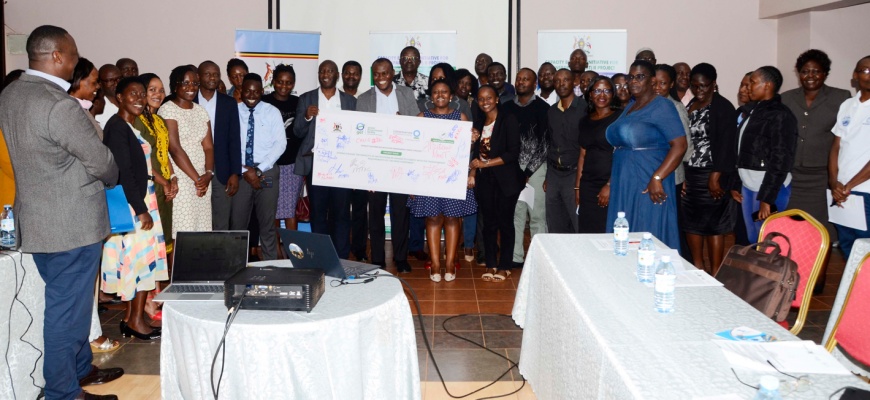
STRENGTHENING THE CAPACITY OF INSTITUTIONS IN UGANDA TO COMPLY WITH THE TRANSPARENCY REQUIREMENTS OF THE PARIS AGREEMENT – CBIT PHASE II
Uganda, as a signatory to the Paris Agreement, is committed to reducing its greenhouse gas emissions (GHG) 24.7% by 2030 and contributing to the global targets. To achieve this, Uganda is required to set up infrastructure that will provide accurate information to track progress towards its commitment to reduce global emissions for Enhanced Transparency Reporting under Article 13 of the Agreement.
Since the completion of the Capacity Building Initiative for Transparency (CBIT) Phase I project in 2020, Uganda’s key emission sectors have made significant progress in developing their sectoral GHG inventories. Funded by the Global Environment Facility (GEF), CBIT Phase I laid the foundation for the formalization of GHG data and information-sharing processes across the key emission sectors. An inter-ministerial Cooperation Agreement covering 10 government institutions and Memorandums of Understanding (MOUs) covering 6 Nationally Determined Contributions (NDC) sectors were signed to promote data sharing. Data-sharing guidelines and data collection tools/ protocols were also developed. The GHG training received by national stakeholders has enhanced their career development opportunities and improved the institutions’ ability to meet their reporting requirements. The Government of Uganda and stakeholders extend our sincere gratitude to the GEF for their trust and continued support, enabling Uganda to maintain project implementation during the COVID-19 lockdown. This support provided us with a valuable opportunity to demonstrate our resilience and adaptive capacity in the face of unprecedented challenges.
While While the first phase had successes, Uganda faces challenges in improving its reporting under the Enhanced Transparency Framework (ETF) of the Paris Agreement. The ETF enhances Measuring, Reporting, and Verification (MRV) processes with flexibility for different capacities. Uganda’s main barriers include weak coordination, inadequate institutional arrangements, limited capacity to collect and manage GHG data, and difficulties accessing data and tools..
On November 1, The Ministry of Water and Environment launched the Capacity Building Initiative for Transparency phase II (CBIT II) project at Silver Springs Hotel in Kampala. The project aims at Strengthening the technical and institutional capacity of Uganda to respond to the ETF requirements of the Paris Agreement. The GEF has provided a $1.5 million grant through Conservation International to support the implementation of the CBIT II project and support reporting under the ETF. The project is implemented by the Ministry of Water and Environment through the Climate Change Department (CCD), in partnership with the Africa Innovations Institute (AfrII). The launch was attended by government officials from different ministries, representatives from non-governmental organizations, the CBIT-Global Support Program (GSP), civil society organizations, research institutions, private sectors and academia.
The Commissioner Climate Change Department, Ms. Margaret Mwebesa, was well represented by her assistant, Mr. Francis Opolot, who assured stakeholders of their steadfast commitment to the implementation of the CBIT Phase II project. He expressed gratitude to the GEF for their support in the execution of the ETF. Mr. Opolot highlighted the significance of Uganda’s CBIT Phase II work, building on the achievements of Phase I, which established data-sharing agreements and cooperation frameworks. Despite successes, the importance of CBIT II lies in in addressing the issues that persisted in Phase I. This phase will focus on enhancing data transparency, reliability, and effective reporting of Uganda’s climate efforts
Dr. Alfred Okot Okidi expressed his gratitude for the support from the Global Environment Facility and its partners, which has significantly advanced Uganda’s greenhouse gas data management through the successful implementation of CBIT Phase I. He highlighted that as we move into Phase II, we should aim to strengthen our transparency framework, ensuring credible and accountable climate actions. Dr. Alfred stated that “this project will promote inclusive development, with a focus on gender equality, and requires active participation from all stakeholders to address data management challenges and ensure accurate reporting. We. encouraged the stakeholders to work together to build a transparent, resilient system that serves as a model for other nations in the region”.
The CBIT II project aims to achieve the following key outcomes:
- Outcome 1.1: Strengthened state and non-state institutions to coordinate and manage the sectoral and national GHG Inventory system.
- Outcome 1.2: Strengthened collaboration and coordination between CCD and other sectors.
- Outcome 2.1: Strengthened technical capacity of stakeholders to collect, process, and analyse activity data and feed GHG sectoral data into the national GHGI.
- Outcome 3.1: Strengthened coordination, learning and sharing between the CBIT II Uganda project and ongoing transparency initiatives.
- Outcome 4.1: A gender-sensitive monitoring and evaluation framework for the project.
The CBIT II project represents a crucial step for Uganda to meet its climate transparency obligations under the Paris Agreement. As the country transitions from Tier I to Tier II of ETF reporting, the need to strengthen the nation’s institutional capacity, enhancing data management systems, and ensuring accurate emissions reporting is great. The outcomes of this project will have lasting benefits, not just for Uganda, but for the wider global community in the collective fight against climate change. By continuing to build resilience and adaptability in the face of challenges, Uganda is proving that with the right support, even the most ambitious climate goals are within reach.
Authored by: Africa Innovations Institute
Edited by: CI-GEF
Key Climate Change Actors Validate The CBIT II Project Proposal Document Before Submission To Donors

Stakeholders at the CBIT II Project Document Validation Workshop at the Royal Suites Hotel, Bugolobi. (Seated: L-R) Dr. Robert Nabanyumya, Lead Consultant-Green Approaches Limited, CI-GEF’s Ms. Laureen Cheruiyot, AfrII CEO-Prof. G.W. Otim-Nape and the Assistant Commissioner-MWE, Mr. Bob Natifu.
15th September 2023– The Capacity Building Initiative for Transparency Phase Two Project (CBIT II) document validation workshop that took place at the Royal Suites Hotel attracted over 50 key climate change actors. Prior, a series of engagements were held with these actors from the Government, key emitting sectors, CSOs, and Academia for stakeholder feedback and to provide further information to the CBIT II project document development. Consultants from Green Approaches Limited (GAL) were contracted to prepare and lead the CBIT II document development process. All meetings held were organized by AfrII and the Ministry of Water and Environment (MWE).
“Today we deliberate on what we believe is a good proposal that will lead Uganda to quality country reporting in fulfillment of our commitment to the Paris Agreement,” said AfrII CEO Prof. G.W. Otim Nape while addressing the workshop participants. He urged the stakeholders present to keenly critique what will be presented, and enrich it for a successful CBIT II project implementation.”
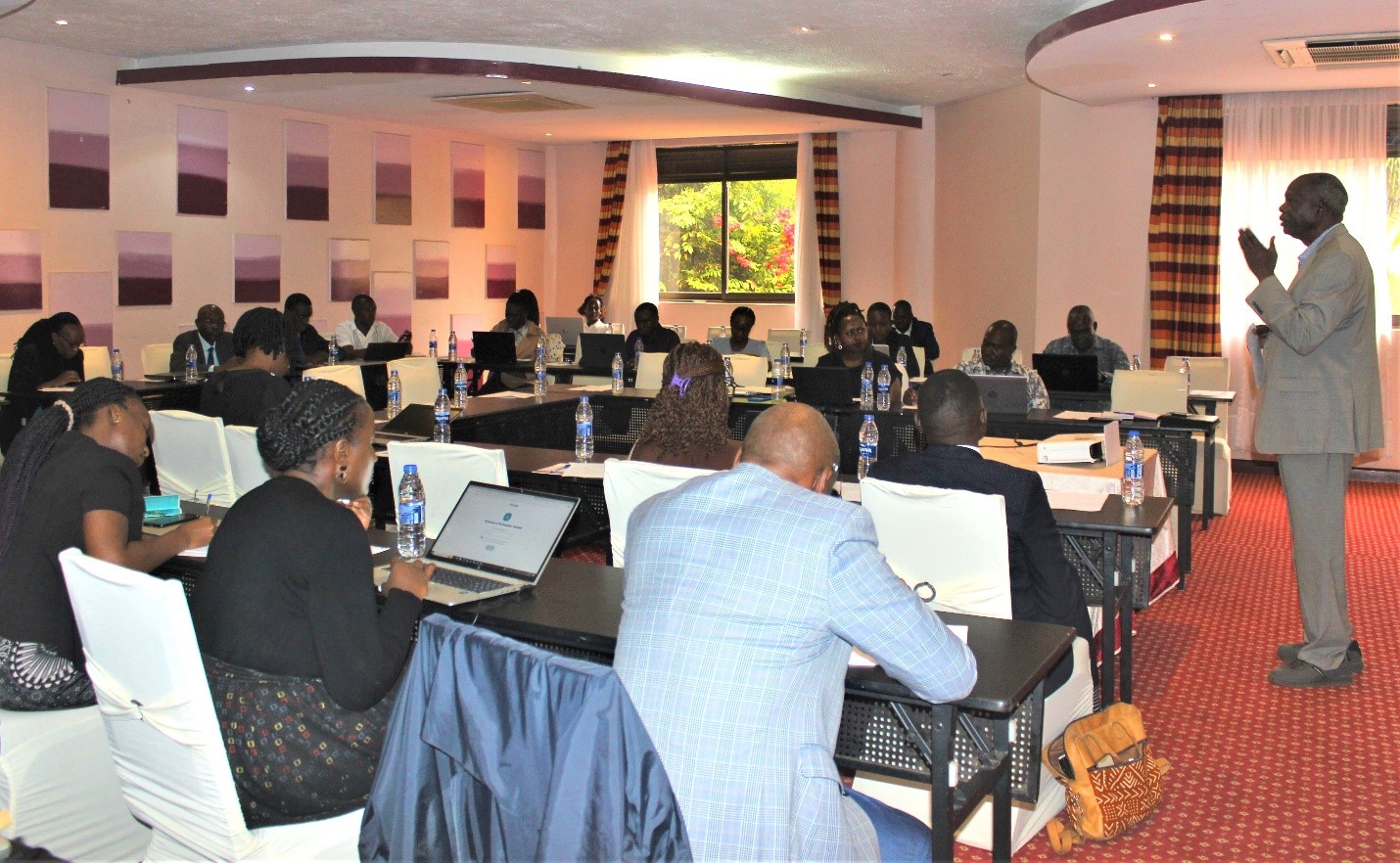
AfrII CEO / Chairman addresses stakeholders during the CBIT II Project document Validation Workshop
Prof. Otim-Nape further noted “CBIT I was a special project because implementation happened during the COVID-19 Pandemic. The project was implemented with passion and innovation to successfully deliver amid the pandemic. It is this innovation that largely led to CBIT I’s success.” He added, “I commend the CBIT I team from AfrII and the Ministry of Water and Environment for the innovations devised to counter the challenges presented by COVID-19 leading to the successes achieved then.” Prof. Otim-Nape further echoed that CBIT II will largely focus on pushing Uganda from current tier reporting to higher tier reporting for Uganda to meet her country’s contributions towards climate action. He concluded his remarks with a vote of thanks. “I want to thank the CI-GEF for providing the support and funding required for the successful implementation of CBIT I and for expressing the same commitment to further provide funding for CBIT II. I also want to thank the consultants from Green Approaches Limited (GAL) for their efforts to put together a clearly thought-out winning proposal document”
Meanwhile, on behalf of the Government, and in his remarks to officially declare the workshop open, the Assistant Commissioner at the Ministry of Water and Environment, Mr. Bob Natifu, urged the stakeholders to shape the project document and proudly own it as vital players in climate action, and take Uganda to where it wants to go in regard to reporting on GHG emissions and related climate action agendas.
in a speech to officially open the workshop, He appealed to the stakeholders to embrace urgent actions on reducing emissions as they are vital players in climate action. He made the remarks/speech to officially open the workshops. while declaring the official kick-off of the workshop.
Speaking on behalf of the funding agency, CI-GEF’s, Ms. Laureen Cheruiyot assured participants that the agency is readily committed to further supporting Uganda’s efforts to meet her national commitments on tracking and reporting on GHG emissions in contribution to global climate action.
The Capacity Building Initiative for Transparency (CBIT I) project (2018-2020) was funded by the Global Environment Facility through Conservation International and implemented by AfrII and the Ministry of Water and Environment’s Climate Change Department (CCD). CBIT II aims to build on the successes of CBIT I.
AfrII pleas to CSOs and Academia to embrace urgent actions toward tracking and reporting on Uganda’s GHG emissions
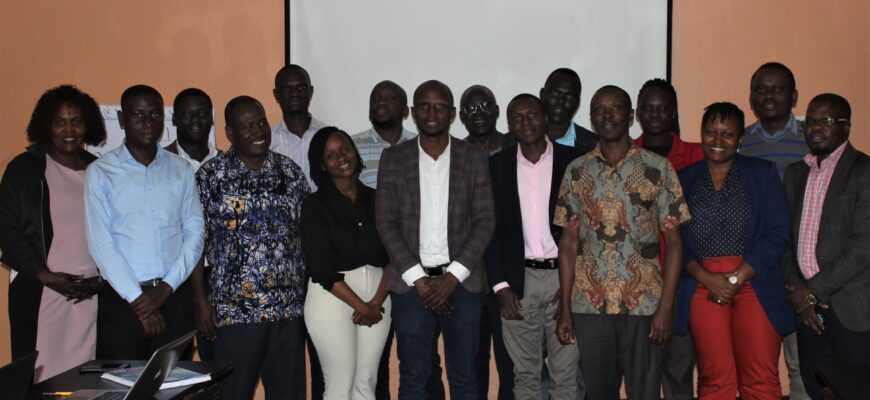
4th August 2023– The Non-State Actors Consultation Workshop for the Capacity Building Initiative for Transparency Phase Two (CBIT II) Project Document Development was held to create stakeholder awareness about the CBIT II Project and determine stakeholder feedback mechanisms for providing further information to the project document preparation process. Consultants from Green Approaches Limited facilitated the workshop organized by AfrII and the Ministry of Water and Environment (MWE) at the Royal Suites Hotel, Bugolobi on 3rd August 2023. Over 20 non-state actors; Academia and CSOs (including the Private Sector) have been engaged and urged to embrace urgent actions on reducing emissions as they too are vital players in climate action.
“We recently held engagements with sector teams that are more directly involved in the industry. Today, we have the non-state actors; academia, CSOs including the private sector because of their importance in this as well. All sectors represented will have a voice in what the CBIT II project is going to achieve and I wish to also inform you that due to the achievements under CBIT I, the GEF-CI has granted us another opportunity to deliver further on meeting our country’s commitments towards climate action. We are indeed grateful to the GEF-CI for this support.” Said AfrII’s GHG Expert Dr. Ben Fungo while addressing the participants.
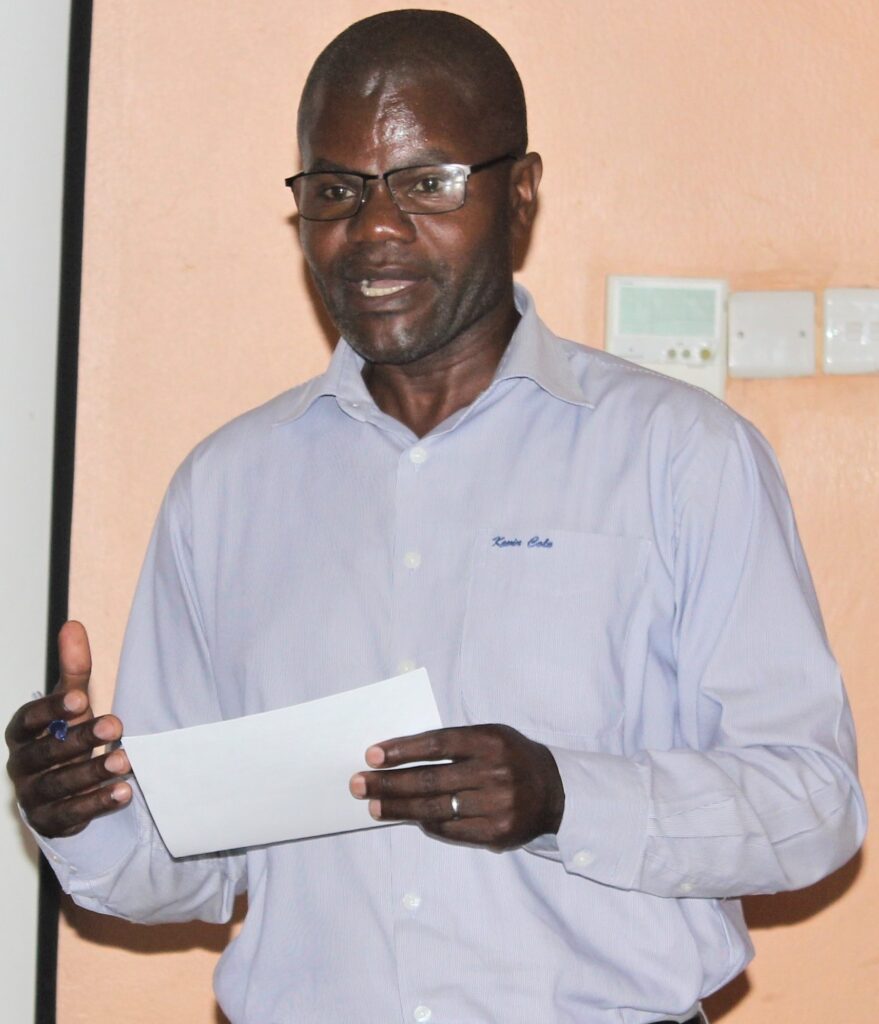
AfrII’s GHG Expert Dr. Ben Fungo addresses the workshop participants
Meanwhile, in her remarks delivered by the Ministry of Water and Environment-CCD’s Mr. Robert Ssenyonga, the Commissioner of Climate Change Ms. Margaret Athieno Mwebesa noted that Uganda is readily committed to supporting and pushing agendas geared towards driving Uganda to meet its national commitments on tracking and reporting on its GHG emissions because it’s committed to contributing to global climate action.
CBIT II will build on the great successes of CBIT I’s ‘Strengthening Capacity of Institutions in Uganda to Comply with Transparency Requirements of the Paris Agreement’ project. CBIT I was funded by the Global Environment Facility through Conservation International and implemented by AfrII and the Ministry of Water and Environment- Climate Change Department (CCD). AfrII and MWE wish to jointly extend appreciation to the GEF-CI for this support.
AfrII Engages Key Stakeholders in the Development of the CBIT Phase Two Project Document
 Friday 21st/07/2023-The National Stakeholders Consultation Workshop for the Preparation of the Second Phase of the Capacity Building Initiative for Transparency II (CBIT II) was held to create stakeholder awareness about the CBIT II Project and determine stakeholder feedback mechanisms for providing further information to the project preparation process. Consultants from Green Approaches Limited facilitated the two-day workshop organized by AfrII at the Royal Suites Hotel, Bugolobi from the 19th to the 20th of July 2023.
CBIT II will build on the great successes of CBIT I’s ‘Strengthening Capacity of Institutions in Uganda to Comply with Transparency Requirements of the Paris Agreement’ project. Under CBIT I, over 80 people were sensitized and trained on GHGI and MRV, Gender focal points were established in 5 sector hubs, the Uganda MRV portal was developed, and 6 sector GHG inventories were developed, among other achievements recorded. CBIT I was funded by the GEF-CI and implemented by AfrII and the Ministry of Water and Environment- Climate Change Department (CCD).
“This workshop is crucial because it highlights the importance of using previous technical expertise and since most of you here have been previously involved in CBIT I, I am confident that this will help us quickly build on what was done and do more on CBIT II. AfrII extends sincere appreciation to the Global Environment Facility and Conservation International for funds availed for the successful implementation of CBIT I. AfrII pledges to support the project as expected and appeals to all actors to similarly fully commit so as to deliver a successful CBIT Phase II project.” The remarks were made by AfrII’s Dr. Ben Fungo on behalf of the AfrII CEO- Prof. Otim-Nape.
In her remarks delivered by the Ministry of Water and Environment-CCD’s Ms. Irene Chekwoti, the Commissioner of Climate Change Ms. Margaret Athieno Mwebesa stated “Uganda benefitted from the CBIT I and made notable progress in enhancing the capacity of national institutions on monitoring, reporting, and verification of emissions. The Ministry is very confident that CBIT II will make an even greater impact on tracking and reporting on Uganda’s GHG emissions. The Ministry extends appreciation to our partners Conservation International and AfrII for joining efforts to seek this support from the international climate finance institutions to benefit Uganda.”
AfrII and MWE wish to jointly extend appreciation to the consultants leading the process of putting together all our ideas into a compelling fundable proposal for the CBIT II project.
AfrII and partners strategize on sustainability approaches towards climate action

Via Zoom: Project partners on the Capacity Building Initiative for Transparency (CBIT) project this morning held the final CBIT Quarterly Project Steering Committee (PSC) and Inter-Sector Meeting to discuss project outputs, achievements and challenges and also propose strategies and recommendations for sustainability of the project outcomes.
Presenting at the meeting, Dr. Felly Tusiime, the CBIT Uganda Project Manager, also Head of Climate Change and Environment Sustainability programme at AfrII said “We need flexibility across the sectors to share data for effective reporting. The expertise within the sectors should actively engage in national sectoral international reporting including UNFCCC e.g TNC and BUR as part of the task force.” Dr. Felly also strongly pointed out the need to operationalise the signed cooperation frameworks between MWE-CCD and the target ministries for sustainability of the project outcomes.
CBIT Uganda is funded by the Global Environment Facility through Conservation International and is implemented by AfrII and the Ministry of Water and Environments’ Climate Change Department (CCD). The project’s 3 key outcomes were: Support establishment and strengthening the institutional arrangements for robust GHG emission inventory and MRV system, build capacity of key stakeholders to collect, process and feed data into the GHG emissions inventory system and test and pilot the Green House Gas (GHG) Emission Inventory and Monitoring Reporting Verification (MRV) system.
CBIT Uganda graduates 60+ national experts on GHG inventory and MRV
The Global Environment Facility (GEF) funded CBIT Uganda project jointly implemented by the Ministry of Water and Environment through the Climate Change Department (CCD) and AfrII, in collaboration with Conservation International (CI) will tomorrow 16.6.2020, launch the 6 sector GHG inventory, and graduate over 60 national experts on GHG inventory and MRV from Energy, Agriculture, Transport, Industry, Forestry, and Waste sectors. The ceremony will take place online via zoom video conferencing, in observance to government restrictions i.e. on public gatherings to curb likely spread of Covid-19.
The Capacity Building Initiative for Transparency (CBIT) Uganda project has supported the CCD-MWE to strengthen capacity of key stakeholders for Greenhouse Gas (GHG) data collection and processing in the target key emission sectors, so as to meet the transparency requirements of the Paris Agreement.
CBIT Uganda Validation workshop
AfrII, partners and stakeholders will on Thursday 21st May 2020 participate in the CBIT Uganda Validation workshop: Final Sector GHG inventory and method statements presentations via zoom platform from 2:00 -5:00 pm.
Since Uganda declared a nationwide lock down in March 2020, as a move to prevent spread of the corona virus, the CBIT Uganda project team has since been engaged in numerous successful zoom trainings and meetings to ensure work carries on amidst the challenging COVID 19 situation.
The GEF-CI funded CBIT Uganda project is implemented by AfrII and the Ministry of Water and Environment-Climate Change Department’s 5 key emitting sectors; Waste, Energy, Transport, Agriculture and Forestry, to support Uganda to track progress towards implementing and achieving her NDCs and reduce GHG emissions.