Reaping big from cassava farming

Mr. Okiror Gilbert a Cassava Seed Entrepreneur (CSE) from Koloin in Ngora District, with his bags of packaged clean cassava stem cuttings he intends to sell to fellow farmers to boost multiplication of clean cassava seed.
Mr. Okiror recently made sales on cassava cuttings / stems worth about 2.5 million Uganda Shillings from clean planting materials of the NaSE 19 variety that he accessed from AfrII through the Cassava Seed Systems Project in collaboration with the CAVA II Project, both implemented by AfrII.
Through the two projects, farmers like Mr. Okiror have readily accessed certified and high yielding disease tolerant varieties of NaROCASS I, NaSE 14, and NaSE 19 of cassava seed for planting, to increase yield production.
He commends AfrII for enabling him access clean seed for multiplication and also for availing him skills and Knowledge in good agronomic practices including practicing row planting of the cassava seed, and timely weeding among others to boost high yield production.
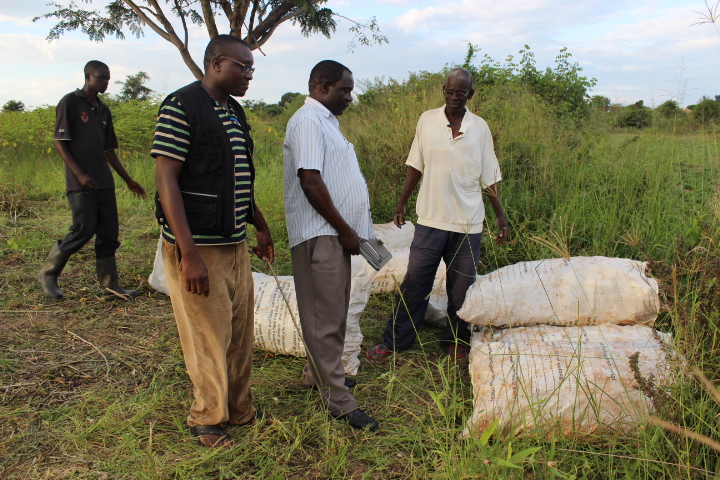
In the photos:AfrII Zonal Manager, Mr. Anthony Ijala (In stripped shirt with black jacket),CAVA II Uganda Country Manager-Mr Francis Alacho (white shirt) and Mr. Okiror Gilbert, a CSE.
CAVA II Uganda gets over 40 new SMEs and CPGs into cassava production and processing

With increased efforts to promote cassava value addition for increased shelf life and better income, new Small and Medium Entrepreneurs (SME’s) and Community Processing Groups (CPGs) in Uganda are increasingly expressing interest in production of High Quality Cassava Flour (HQCF), which interest is largely attributed to the CAVA II Uganda project. The 48 new SME’s and CPGs are from the Northern part of Uganda.
In the month of August alone this year, 33 new SME’s and CPGs in Teso and Bullisa areas were initiated into active HQCF processing. Among these is Landmark Millers Limited in Soroti district (SME), Koloin Agro-processors in Ngora district (SME), Teso farmers in Soroti district (SME), Kokom in Pallisa district (CPG), Kokong Village SACCO in Ngora district (CPG), and Marshall cassava in Bullisa district (SME).
In the Lango region over 15 SMEs and CPGs were adopted including ORIB CING Women Group in Alebtong district (CPG), Twomo Emmanuel in Apac district (SME), IGEL Cassava Growers in Kole district (CPG), Ongica Farmers Group in Lira district (CPG) and Divine organic foods in Lira district (SME).
Since their initiation, the project has availed them trainings in the areas of quality assurance in value addition with targets to have traceability to ascertain quality in cassava processing. The project has also linked these with clean planting materials through collaboration with the Cassava Seed System project in which certified and high yielding disease tolerant varieties (NAROCASS I, NASE 14, and NASE 19) of cassava seed have been readily accessed for planting, to increase yield production.
One of the beneficiaries on board, a new SME and CSE is Mr. Okiror Gilbert of Koloin Agro-Processors, located in Koloin, Ngora District. He has adopted use of raised metallic sun drying racks for drying his processed cassava. He accessed these racks through the CAVA II Uganda project that is being implemented by Africa Innovations Institute (AfrII). With this new technology, Mr. Okiror is able to achieve drying in 3 -4 hours and then mill into flour. The technology has also saved him the burden of drying cassava on bare ground.
‘I have been a cassava farmer for a long time but it is just of recent after I was discovered by CAVA II that I have greatly improved in this business. I started on cassava multiplication and processing, and currently with my 10 acres of cassava I can now produce better varieties of cassava and supply of roots for processing is no longer a problem. With the knowledge CAVA II has availed me, I’m also passing on this knowledge to other farmers and I can tell you, a lot is changing in their lives as well”. Says Mr. Okiror
With the trainings received from CAVA II Uganda, Mr. Okiror has managed to reach out to fellow farmers and passed onto these, services including availing farmer to farmer skills enhancement (pay a Visit and learn), training youth on good agricultural practices such as proper spacing, row planting, weed management, and timely harvesting. The value addition demonstrations are widely impacting on the whole community and many have turned to cassava production. He has also established a farmer to farmer saving club in which at each sitting each farmer gives in a savings of 1000 Uganda shillings.
Mr. Okiror acknowledges CAVA II Uganda for the support including availing him processing skills and techniques to obtain High Quality Cassava Flour and access to clean cassava seed for multiplication business. He accessed the NASE14, NASE 19 and NAROCASS1 varieties that he is currently farming, through CAVA II Uganda.
Another beneficiary SME is Landmark Millers Limited in Soroti district, managed by Mr. Okubal Charles-the Director. His vision on cassava includes an inclusive out grower’s business model to sustain cassava root supply and has set up mother gardens from which farmers can access new varieties of good quality planting materials. He has been in the processing business dealing in maize milling but has now dedicated part of his milling unit to process High Quality Cassava Flour (HQCF).
‘we have a very big dream for cassava and we are going step by step. I have embarked on establishing raised metallic drying racks at all processing sites based in the rural setting. Before we met CAVA II Uganda, we had so many challenges, struggling with cassava, drying it on the ground and with my mill being by the roadside you can imagine how the quality was being affected. Cassava is here all year round and cassava for me as a person from Soroti, is the staple and so if we have to sustain and improve livelihoods of our people, we need to promote what we locally depend on, add value to it and promote it further than just a crop for food” Mr. Okubal remarks.
Also, with his growing network of cassava farmers, Mr. Okubal hopes that with time, the challenges to do with scarcity of the cassava crop will be addressed. “Our network is such that we have six registered sub-counties with 10 groups of farmers registered with us. We also have some farmers outside the network which keeps growing by the day thanks to CAVA II. We have tasked farmers to each give the mill 1 acre of cassava of the certified planting material. In Ngora, for example our farmer group has already planted some new materials on their 10acre plot. We have also agreed that Landmark millers must have at least 10 acres in each location to act as the mother gardens for seed multiplication. With CAVA on our side, we are going to be rest assured of the material we circulate, because so far, through them, I have been able to access clean planting materials to sustain the fresh cassava root supply for my mill”
He followed the advice availed by CAVA II and has since had a break through in supply, being one of the major suppliers of cassava flour to the breweries. “We are expected to supply about 200 tons of cassava flour to UBL for their Ngule beer but we also have the regional markets, like Rwanda and South Sudan buying from us” says Mr. Okubal who is also hopeful to obtain the flash dryer technology in the near future.
The AfrII Zonal Manager- CAVA II Uganda, Mr. Anthony Ijala says that the growing interest the SME’s have gained in the project is proof that a lot is being done and appreciated. “when you see SME’s like Mr. Okubal of Land Mark Millers getting on board, this is a good thing. His interest with the CAVA project has pushed him to achieve bigger in as far as processing. He has a growing farmer network and has embarked on a lot of demonstrating with a lot of new planting materials of varieties like NAROCAS 1, NASE 14 and NASE 19. The varieties give a yield of 30 tons per hectare and these are yields that are very hopeful for Uganda to sustain the cassava processing sector”
‘Another exemplary new SME, Marshall Cassava in Bullisa district have taken it very seriously and have so far set up 5 sets of raised metallic drying racks and a solar screen dryer. These are achievements we are proud of as a project but we also have to acknowledge the willingness of many farmers out there to embrace new technologies” adds Mr. Ijala.
The CAVA II team has been greatly influential in all these steps and special acknowledgements are attributed to the Zonal team including the Zonal Manager, Mr. Anthony Ijala and the Zonal officer, Mr. Summuel Baker Ogwang. Also sharing in this glory is the CAVA II Uganda Country Manager, Mr. Francis Alacho, the CAVA II Uganda technical advisor Professor G. W Otim-Nape, also the AfrII Chairman, the BDE’s and the rest of the CAVA II Uganda team, whose continued efforts in improving cassava production under the CAVA II project is greatly benefitting.
The Cassava Adding Value for Africa Phase 2 (CAVA II) Project supports adding value and commercialization of cassava in Africa. The CAVA II project has successfully developed value chains for HQCF, by supporting investors to establish HQCF processing sites in Eastern, Northern and Central Uganda. The current investors include community processors, SMEs based on sun and solar drying. The project also facilitated processors to supply on contract arrangements HQCF to end user industries such as rural bakeries, beer breweries and biscuit manufacturers who use it to make composite flour, beer and biscuits respectively. CAVA II is being implemented in 18 districts including Pallisa, Kibuku, Budaka, Bukedea, Kumi, Soroti, Ngora, Serere, Dokolo, Nakaseke, Nakasongola, Lira, Apac, Otuke, Oyam Kole Kaberamaido and Alebtong.
CAVA II project beneficiaries include; Smallholder farmers, Small and Medium Enterprises and selected projects working on cassava value chains, among others.
The project is also being implemented in 4 other countries of Nigeria, Ghana, Tanzania and Malawi.
AgriTT Partners meet over feasibility study on large scale cassava industrialization in Uganda
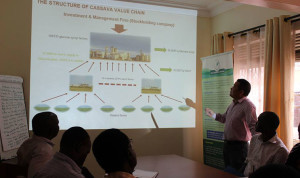
Experts from China and UK jointly with experts from AfrII have teamed up to conduct a Feasibility Study on Large Scale Cassava Industrialisation in Uganda. The experts undertaking this study are exploring the areas around Investment and Finance, i.e a look at the wider situation for investment in larger scale processing of cassava in Uganda and also building a cassava industry in Uganda.
This study is under the Agricultural Technology Transfer (AgriTT) Project of which AfrII is an implementing partner.
The experts including Dr. Liang Guo Tao from China, Dr. Andrew Graffham and Mr. Ulrich Kleih of NRI were recently hosted at the AfrII secretariat boardroom for presentations on findings so far of the ongoing study.
CAVA II project partners review the project operation in Uganda

AfrII recently hosted partners on phase two of its Cassava: Adding Value for Africa (CAVA II) project on a 3 day’s project review and update visit trip. These included the CAVA II Nigeria team, the Project Director Professor Kolawole Adebayo and his communications assistant Halimat Badmus and the NRI team had Richard Lamboll and John Linton. The visit of August 14th-18th included a series of activities like a tour of the two flash dryer factories in Lira and Apac Districts as well as field visits to SME, CSE and CPGs as beneficiaries of the CAVA II project.
The country manager CAVA II Uganda Mr. Francis Alacho briefed the partners on the milestones CAVA II Uganda has achieved since its inception in March 2015. He said “So far, we have fully installed two flash dryers in Lango sub region. The project has also generated high interest from local investors. These newly embraced investors are being supported by the project in areas of processing cassava into HQCF. We are training them on among other things, quality standards of processing HQCF”
The CAVA II Project Director, Professor Kolawole Adebayo from FUNAAB, Nigeria in his remarks during a meeting held at the AfrII secretariat commended CAVA II Uganda on progress in the areas of value chain addition through promoting processing of cassava into HQCF by the SME’s, CPGs and other actors in this value chain.
Professor Kola also hinted on how far the project has come and said “The work we are doing all across Africa has been a very interesting journey. For many people, when we started they couldn’t believe that cassava could be what it is today. I’m particularly delightful that here in Uganda in addition to the interests that have been generated, people have actually committed their own resources as a proof of belief in what we are trying to do.”
He also spoke of the newly adopted technologies by the Ugandan investors “One can only hope that the dream we have will materialize quite soon, particularly with two new flash dryers being installed in the country with the brewing industry buying so much cassava for beer, with people in the other sectors like biscuit and bakeries, looking at cassava as a way to reduce their import deals. And so with such tremendous progress, I think the work we have been doing together has been very beneficial to individuals, investors, the country and to people whose livelihoods revolve around cassava.”
Meanwhile AfrII Chairman, also the CAVA II Uganda Technical Advisor, Professor G.W Otim-Nape commended the partners for their continued support towards CAVA II Uganda, which support he says has largely contributed to its ability to achieve its specific project targets.
The Cassava Adding Value for Africa Phase 2 (CAVA II) Project supports adding value and commercialization of cassava in Africa. The CAVA II project has successfully developed value chains for HQCF, by supporting investors to establish HQCF processing sites in Eastern, Northern and Central Uganda. The current investors include community processors, SMEs based on sun and solar drying. The project also facilitated processors to supply on contract arrangements of HQCF to end user industries such as rural bakeries, beer breweries and biscuit manufacturers who use it to make composite flour, beer and biscuits respectively.
In Uganda, CAVA II is being implemented in 18 districts of Pallisa, Kibuku, Budaka, Bukedea, Kumi, Soroti, Ngora, Serere, Dokolo, Nakaseke, Nakasongola, Lira, Apac, Otuke Oyam, Kaberamaido, Kole and Alebtong. The project is also being implemented in 4 other African countries of Nigeria, Ghana, Tanzania, and Malawi.
CAVA II project beneficiaries include; Small holder farmers, Small and Medium enterprises, and selected projects working on cassava value chains, among others.
Farmers urged to Intensify production of drought tolerant crops

As the world today jointly commemorates the World Food Day under the theme “Climate is changing. Food and Agriculture must too” agricultural experts at the Africa Innovations Institute (AfrII) shared a message that to address hunger and food insecurity issues, there is need to intensify production of drought tolerant crops including cassava, sweet potato, sorghum and millet. With climate challenges affecting crop life today thus resulting into shortage of food, these drought tolerant crops are regarded as the ‘foods of the future’.
Today, the world is witnessing an unprecedented wave of food crises/ emergencies linked to climate change and natural disasters. This has largely affected the food security issue and this can have severe consequences for long –term food sustainability, says Africa Innovations Institute (AfrII).
“one of the crops likely to save us is cassava because cassava grows over a period of about 5 months. The cassava crop will experience all the extreme weather events that are accompanying climate change like drought. If there is prolonged drought/ dry season you will find the cassava in the ground, if there is too much rain, you find the cassava in the ground. If there are hailstorms, you will find the cassava in the ground. Studies have found that cassava is going to be the most resilient crop that we as a country should be looking at for food security” CAVA II Uganda Country Manager, Mr. Francis Alacho said addressing Uganda press on Friday, 14 October 2016.
Climate change is one of the biggest threats to food security. The increasing frequency in Weather related disasters, higher temperatures (dry spells) are affecting crop life in many agricultural based areas, like Northern Uganda which has suffered long sequences of dry spell in the two last seasons of production affecting many crops.
A study on how the weather/ climate has been behaving over the past 30 years (1980-2010) revealed a shift in the weather patterns, that is, the first season that normally starts around March –June is becoming drier and the rains are reducing. Over the 30 years the rains reduced from about an average of 50mm per year. On the other hand, the temperatures over the last 30 years during the first rains increased by an average of 2 degrees Celsius (This is quite significant when it comes to crop production because some of the crops and even animals are sensitive to such weather increases).
“When you look keenly at this data, you notice that the first season is becoming un favorable for crop production and yet traditionally in Uganda, these are the long rains that used to give us very good harvests” Mr. Alacho said noting that the second rains that come between August to around November are increasing by an average of about 60mm over the generation of 30 years but the increase in temperature is also the same increase of about 2 degrees Celsius.
“From this study we did remodeling to see the predictions over the next 30-50 years of which we found out that this pattern is going to continue. We are going to see the first rains becoming less and less whereas its becoming hotter. Whereas its going to continue that the second rains are going to become wet and wetter while it is still hotter” This elaborately shows that climate is changing and this is affecting production of food for people to survive on, and so crops like cassava must come into play to address the food situation.
In his address, Professor Otim-Nape, Chairman AfrII says “Enhancing food security for all is a fundamentally important topic. Our work at AfrII covers the whole of Uganda and we are able to understand the food situation in Uganda for which we intend to come up with solutions to curb this food crisis situation affecting us. Our work has established that we are still not food secure and many families don’t have enough food to eat. These families produce food, but around March, April, May the food stocks dwindle and people become desperate. To address this, therefore, we need farmers in Uganda to adopt intensive farming of these drought tolerant crops, especially Cassava”
“In order for us to achieve food security in a rising population, we have got to move aggressively to innovations, innovations in terms of enhancing soil fertility to produce more to feed many. The soil nutrient levels in many of the areas countrywide has really gone down, therefore if we are to address the food insecurity issue, we need to enhance the fertility of the soil so that yields can begin to go up” adds Professor Otim-Nape.
Mr. Stephen Kwesiga, a BioPysical scientist under the Vital Signs project at AfrII also had this to say to the media “Population is growing every now and then and to have a food secure nation, we shall need to increase food production by around 70 to 100% if we are to meet the current need for food to eliminate hunger. But to do this, there are a number of things we should put right”
“There is a lot of food insecurity and the production is very low, not because people aren’t hardworking but because of the challenges they are going through. What Vital Signs is addressing currently is to provide near real time data to decision and policy makers to guide agricultural development initiatives in the country. We collect soil samples from all round the country and analyze these, and through our analyses, we have come to discover that most of our soils in Uganda are depleted. We believe all these soil related challenges need to be addressed if we are to become a food secure country” he adds.
Also, Dr. Joweria Nambooze, a nutritionist at the institute says “we are using nutrition sensitive approaches. When we improve production, we want to make sure that ultimately, this production will enhance nutrition at the end of the day. We promote production of climate resilient crops like sorghum and millet that are also quite nutritious as these not only help in the fight against climate change but also promote food security”
AfrII’s theme for the World Food Day is “Advancing food security in achieving SDG 2: End Hunger, achieve food security and improved nutrition and promote sustainable agriculture”
On a whole, Uganda has commemorated the day with celebrations held in Ngeta, Lira district.
CAVA II Uganda is advised to adopt other improved technologies to boost cassava

Dr. Ola Ogunyinka, NRI’s Senior Research Fellow Monitoring, Evaluation and Impact Specialist has recommended that the CAVA II Uganda project looks into other drying mechanisms that are affordable to most of the farmers (small holder farmers). He particularly pointed out a possible look into the inflatable (Collapsible) solar drying technology that is already being used in Ghana and that Uganda can learn from their experience with this new technology and adopt it as well.
He noted that the successful establishment of the 3 improved varieties (NASE 14, NASE 19 and NAROCASS 1) in partnership with the cassava seed systems project will greatly boost Fresh Cassava Root (FCR) supply and thus greatly contributing to the targets of CAVA II Uganda.