Partners visit project areas on progress of their research work on the rice crop

Last week, AfrII hosted partners on the Enhancing Rice Markets in Uganda through Smart Micronutrient Fertilization (ENRICH) Project to field visits to witness progress of the experimental trials established at Doho and Kibimba rice irrigation schemes in the two districts of Butaleja and Bugiri, respectively. The Project under collaborative research efforts aims to address rice nutrient problems through testing and recommending best micro and macronutrient fertilizer combinations and application methods that give best yield results for farmers. The partners interacted with the farmers of both FRGs to share ideas on enhancing nutrient use to increase rice productivity.
Scientists at the Africa Innovations Institute (AfrII) successfully set up experimental trial plots in the two districts with the involvement of Farmer Research Groups (FRGs). These have been trained for their efficient involvement in evaluating the experiments, and selecting the best fertilizer combinations and management practices that will give the best rice yields, and can be integrated into their current management practices.
“In this phase of the research, we engaged a few farmers but we intend to involve all farmers from the different sub counties during the on farm trials.” says Thomas Awio, an agronomist at AfrII. 10 farmers were selected under the FRGs to participate in the experiment.
“By actively engaging the farmers in this research, we want them to learn and efficiently put to use the technologies being extended to them. They can then act as ambassadors of this work and share the knowledge obtained with other farmers outside the project so as to thrive rice productivity” remarks Professor Otim-Nape, the Chairman, AfrII. The Project is extending to farmers’ new ways of growing rice, new varieties and how to grow these with fertilizers.
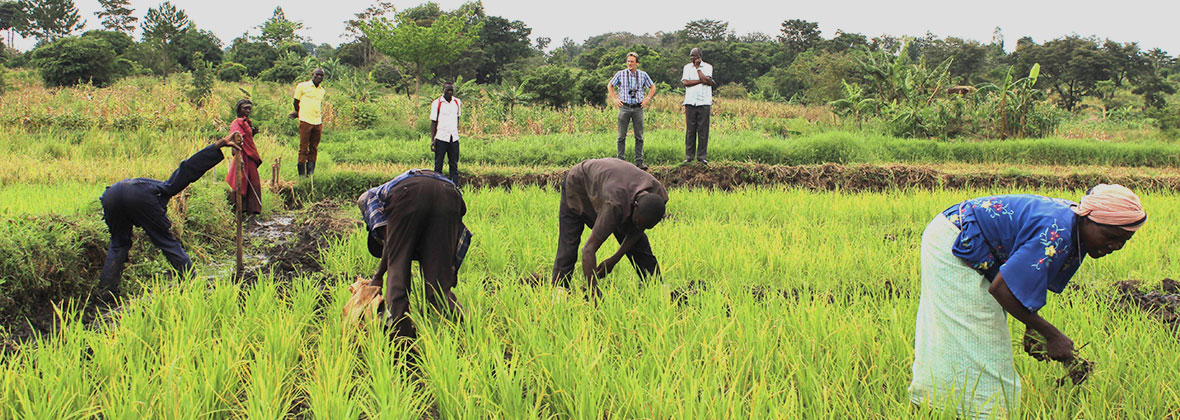
Farmers under their FRG engage in weeding on the rice trial plot in Kibimba. Looking on Far back is Professor Otim-Nape, the AfrII Chairman and Dr. TjeerdJan Stomph of Wageningen
One of the Partners on the Project, Dr. Christian Dimpka, a fertilizer expert from the International Fertilizer Development Centre (IFDC) hinted that fertilizers are a major driver of yield increase. He advises that micronutrient fertilization be taken more seriously if a farmer is to gain more from their rice farming efforts. “A farmer should always test their soil to determine what type and amount of nutrients to add in the soil. A farmer will increase productivity from 20% to 50% if they apply fertilizer and properly manage the crop.” He adds that if a farmer has been getting 5 dollars on a field, they can get 75 dollars when they ably use fertilizer on the crop.
Another partner on the project, Dr. SenthilKumar Kalimuthu, an agronomist at the Africa Rice Centre advised that farmers should use varieties resistant to disease if they are to gain more from their rice fields. “In the experiment at Doho, we are using the K98 variety because it is blast susceptible. We have observed that by applying nutrients, both micro and macro, the fertilizers can reduce the incidence of blast diseases on this variety.” Says Kalimuthu.
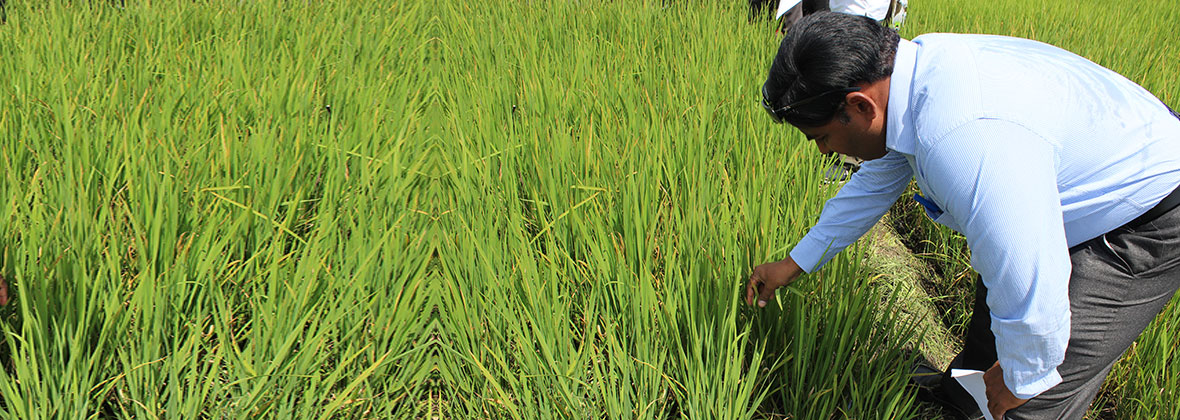
Dr. Kalimuthu of Africa Rice observes a rice plant on the trial plots at Doho rice irrigation scheme
Farmers have appreciated the technologies and are excited in utilizing them to sustain productivity of other crops apart from rice. Ms. Faridah Akwi, the Vice Chairperson of the FRG in Kibimba, Bugiri, happily relays their gratitude. “We appreciate AfrII and partners for making us part of this research work. We intend to share the knowledge and skills extended to us through this project to other rice farmers.” “We have been trained on the best technologies including row planting, timely transplanting, weeding and application of fertilizer and micro nutrients to the fields to improve yield productivity.” Farida says.
Farmers in Uganda nearly use no fertilizers on rice yet the use of fertilizers comes with a number of advantages like increasing yields (0.8 to 1.5 t/ha – lowland rice) and (1.5 to 2.5 t/ha-upland rice). Micronutrients have been reported to enhance uptake efficiency of NPK, improving rice grain yields, profit margins, grain nutritional quality and disease tolerance. The different fertilizers being evaluated are nitrogen (N), Phosphorus (P), Potassium (K), Zinc (Zn), Manganese (Mn), Boron (B), sulphur (S) and a commercial micronutrient fertilizer Elfert-F.
The ENRICH project funded by the Government of the Netherlands is a partnership between Africa Innovations Institute (AfrII), Virtual Fertiliser Research Centre of the International Fertilizer Development Centre(VFRC-IFDC)-Washington DC, Africa Rice Centre (Africa Rice)-Tanzania, Wageningen University (WUR)-Netherlands, International Soil Reference and Information Centre (ISRIC)-World Soil Information, Netherlands, FICA Seeds Limited, and Wind Wood Millers Limited.
Are benefits from agricultural intensification related to household income, level of education, and gender? – results from 758 households in Uganda, Rwanda, Tanzania and Ghana
By Robert Shaffer, Vital Signs Fellows &Scientists_DSSG 2017 ,Africa Innovations Institute,Tanzania Forest Conservation Group,Wildlife Conservation Society Rwanda,The Council for Scientific and Industrial Research Ghana
This analysis is a result of the collaboration between the eScience Insitute Data Science for Social Good Program and Vital Signs. Learn more about this program here.
In developing countries, agricultural intensification (defined as increased input per unit of land) is a key phenomenon of interest. These inputs may include land, fertilizers, pesticides and labor including use of agricultural machinery. Increasing agricultural intensification can contribute to aggregate-level increases in food availability and economic performance. However, these benefits may not be evenly distributed, largely based on unequal access to key inputs, either across landscapes or countries or according to some demographic feature of interest.
For the purposes of this study, we focus on investigating gender- and income-based equity outcomes as they relate to availability and usage of agricultural inputs. Previous studies examining the relationship between gender and input usage have returned mixed results; [1], for example, found organic fertilizer usage is substantially higher in male-headed households than female-headed households. By contrast, usage of improved fallows is largely unrelated to gender of household head. Here, we extend this investigation across an array of agricultural intensification indicators, and examine how usage of these inputs varies by gender and country in the Vital Signs dataset. We conclude by examining the relationship between input usage and landscape-level income and education equity outcomes.
Prominent cassava farmer sets up millions worth cassava commercial building
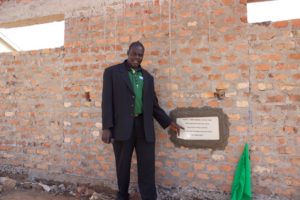
Mr. Akuttu in front of his millions worth cassava commercial house
Mr. Akutu Augustine is one man whose tale with cassava is quite admirable. He is earning big both as a cassava farmer and a cassava processor of the High Quality Cassava Flour (HQCF). He is also highly recognized as influential in the community and is praised by not only by the community persons but also the local area/ community leaders of the church and political statures.
Mr. Akutu is reaping big as a cassava farmer. He makes proceeds worth millions from selling cassava seed. “I harvested 3,500 bags of cassava stems in 2016 and earned 170 million, this year I supplied 1,275 bags and earned 60 million Uganda Shillings” says Akutu. From the sales made last year, he bought land and also bought a tipper/ lorry that he now uses to ferry cassava from his farm to the processing site at his home. He additionally set up new structures at his home in Amuria district, bought more 4 acres of land that cost him about 64 Million UGX on which to grow more cassava. He also bought an additional 80 acres to plant the NASE 14 and NAROCASS 1 varieties.
Akutu’s highlight is the newly established cassava house that he has set up in Soroti town, Eastern Uganda. “I bought the plot last year in 2016 at 40 Million Uganda Shillings but expenses shot up to about 52 million” remarks Akutu. This year, the earnings he made from cuttings he supplied on contract to the Government NAADS Programme are what he used to begin setting up the structure. His plans are to use part of the commercial building to exhibit cassava products for sale. The back area will be used as lodging quarters.
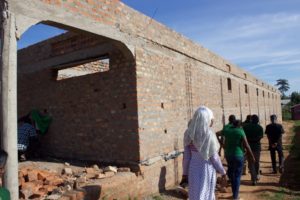
The CAVA II team inspects Akutu’s cassava house still under construction
“I want this building to be a lodge /guest house that will earn me some money. I intend to save up to be able to obtain the cassava flash dryer. I have all this cassava all over Eastern Uganda and I know that we need a cassava factory here” says a smiling Akutu. His cassava gardens of over 500 acres are spread out all through the districts of Amuria, Soroti and Serere.
In an interview with AfrII’s Communications Officer, last year, Mr. Akuttu disclosed his plans to set up the commercial building. The 15 roomed building is worth over 100 Million Uganda Shillings and he intends to finish construction this year for it to be operational.
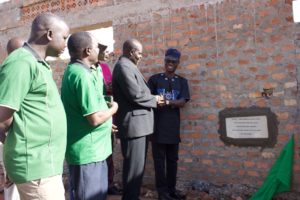
Prof. Kolawole of FUNAAB launches the cassava house and congratulates Akutu on his achievement
The CAVA II Project Director, Professor Kolawole Adebayo launched Akutu’s cassava house during a recent visit to Uganda on progress of the CAVA II Project implementation in the country.
The CAVA II Project is implemented in five African Countries of Nigeria, Malawi, Ghana, Tanzania and Uganda to increase the incomes of smallholder farmers (SHFs) and community processors through participation in profitable and sustainable value –added cassava chains. In Uganda, specifically, it is implemented in parts of Northern, Eastern and Central Uganda in 21 districts with aim to create by 2019 an annual demand for 69,030 tons of Fresh Cassava Roots (FCRs) from smallholder farmers and incomes from sale of fresh roots and processing by smallholders will generate at least USD 4.5 Million per annum for rural communities.
CAVA II is funded by the Bill and Melinda Gates Foundation. The project receives technical back stopping from the Natural Resources Institute-University of Greenwich (NRI) and the International Institute of Tropical Agriculture (IITA).
CSS Project supported farmer gets accolade for best Cassava Seed Entrepreneur
Successful cassava farmer and beneficiary of the Cassava Seed Systems Project (CSS), Mr. Akuttu Augustine recently won an award for “Best Cassava Seed Entrepreneur 2013-2017” under the Cassava Seed Systems Project. Mr. Akutu, a resident of Amuria district in Eastern Uganda was also awarded a certificate of inspection on fulfilling the quality and plant health standards for cassava planting materials. The certificate qualifies him to supply certified cassava stems for planting during the year 2017. He got the two credits in June 2017 this year.
Mr. Akuttu owns over 300 acres of cassava spread out in parts of Amuria, Soroti and Serere districts. Last year, in 2016, he made sales of 170 Million Uganda Shillings from 3500 bags of cuttings sold. This year, he supplied 1275 bags of stems and earned 60 Million Uganda Shillings. He has also been contracted by the Government’s National Agricultural Advisory Services (NAADS) to supply cassava cuttings to neighboring districts including Abim.
His proceeds have been used to among other things, buy more land to expand acreage to grow more cassava, set up new constructions at home and a commercial building in Soroti town.
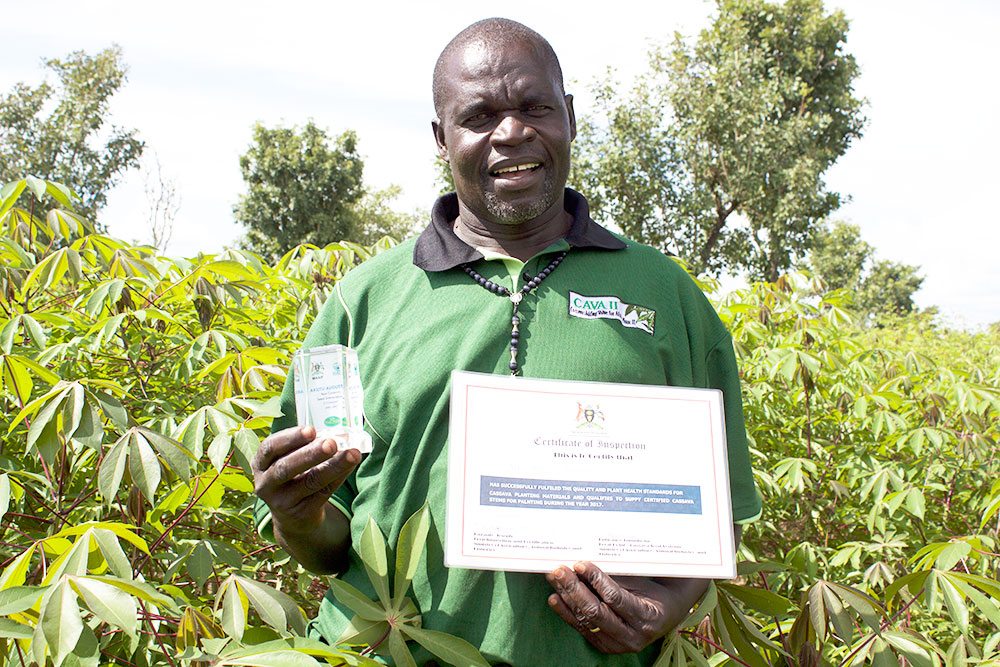
Mr. Akuttu shows off his accolade and certificate earned from his efforts as a dedicated CSE
Also recognized with a similar certificate is Mr. Sam Opio, another successful Cassava Seed Entrepreneur and owner of Adyaka Farm in Apac district -Northern Uganda. Mr. Opio owns over 150 acres of cassava and is still expanding his acreage with aim to further boost his cassava business but also to ensure sustainable root supply for his cassava Flash drying factory of Adyaka Wholesalers Limited, also located in Apac district.
As a certified seed entrepreneur, Mr. Opio has been contracted to supply cuttings to the Government’s Operation Wealth Creation (OWC) this year, 2017. Also, in 2016, last year he supplied cuttings to OWC and earned 200 Million Uganda Shillings.

Mr. Opio with his certificate of recognition as a certified Cassava Seed Entrepreneur (CSE)
The Cassava Seed Systems Project (CSS) aims to catalyze the establishment of a functional cassava seed system to effectively regulate the production and dissemination of quality cassava planting materials in Uganda so as to improve food security and livelihoods of the small holder farmer through timely and cost effective access to disease free cassava planting materials.
The key implementers of the project are the Africa Innovations Institute (AfrII), National Crops Resources Research Institute (NaCRRI), CHAIN Uganda, BioCrops and the Ministry of Agriculture Animal Industry and Fisheries (MAAIF).
Are the effects of extension services on crop productivity moderated by farmer’s education attainment? Results from 25 Landscapes in Uganda, Rwanda, Tanzania and Ghana

This analysis is a result of the collaboration between the eScience Insitute Data Science for Social Good Program and Vital Signs. Learn more about this program here.
Existing studies of farmer field schools (FFS) have found that these programs exhibit a sizable positive effect on per-acre crop productivity value among households with lower educational attainment, with negligible effects on higher-education households[1] [2]. In these analyses, we examined whether a similar effect can be observed when examining a broader set of extension services.Agricultural households in Vital Signs landscapes were therefore asked whether they received extension services in the past 12 months. The categories of extension services used in this study were Agricultural Production, Agro-processing, Marketing, and Livestock Production.
In the analyses,we examined the effects of extension services on crop productivity and if these services were moderated by farmers’ educational attainment. To measure receipt of extension services, we counted the total number of instances in which a given household received advice on any of the topics measured in the Vital Signs dataset. For example, if a household received advice from two sources on Agricultural Production and one source on Agro-processing, we counted that household as having received three extension instances.
For education, previous studies [2] have measured education using educational attainment of the head of the household. However, based on our team’s experience providing and examining extension services in the region, we argue that the maximum individual-level educational attainment represents a better measure. Older household members often receive fewer opportunities to study than their younger counterparts, who may be able to “translate” advice.
Otherwise, to maintain consistency with existing work we attempted to maintain the same set of independent variables as those used in  [2]. In particular, we controlled for country, total area farmed, household size, age of household head, gender of household head, and median household-level field distance to road and market. We also included variables corresponding to field ownership and shared field usage, discretized into “All Owned”/“Some Owned”/“None Owned” and “All Shared”/“Some Shared”/“None Shared”, respectively.
Do female-headed households have less access to agricultural capital and services? results from vital signs data from 26 African landscapes

By Matthew Cooper, Felly Tusiime, Madeleine Nyiratuza, Kame Westerman, Tabby Njung’e, Alice Ruhweza, Peter Alele and Alex Zvoleff
In the struggle to produce more food sustainably, create economic growth, and improve health outcomes across the developing world, women play a pivotal role. Women often assume different agricultural roles than men: they grow more garden crops while men grow more commodity crops and field grains[1]. Women are also generally charged with childcare and eldercare, and pay more attention to household nutrition and child health. At the same time, women also face significant burdens in patriarchal societies where they have less access to land and income. Due to a range of legal and cultural constraints across Africa in land inheritance, ownership, access, control, and use, women make up only about 15 percent of agricultural land holders[2],[3]. However some countries are making more progress than others in the push for equality: in Rwanda, for example, women and men have equal rights to men with regard to land ownership, inheritance, access, control and use.
Vital Signs analyzed data it collected in Uganda, Rwanda, Tanzania and Ghana to identify the key differences between female headed households and male headed households. The data Vital Signs has collected supports these narratives. We used data from 820 households – 140 of which were headed by women – to analyze characteristics that were noticeably different between households headed by men and households headed by women. Some of the starkest differences are in women’s access to agricultural capital. Women own and farm smaller areas, and they use fewer pesticides, herbicides, or purchased seeds (see below). This jibes with global data, which shows that female farmers only receive about 5% of agricultural extension services, while only 15% of the world’s extension agents are women[4].
visit the Vital Signs website to read the full post.
For the live post on CI Connect: Click here to view.
Can forests buffer against malnutrition? evidence from vital signs data monitoring in Uganda

By Matthew Cooper, Tabby Njung’e, Alice Ruhweza, Peter Alele, Felly Tusiime and Julius Okwadi
Many studies have demonstrated how forests and natural areas can improve dietary diversity[1], food security and nutrition[2]. Forests provide a greater variety of foods than agriculture alone[3], and can remain productive even during times of drought and climate stress, when agriculture fails. People in rural parts of the developing world depend directly on forest food products like bushmeat, fruit, nuts, insects, leaves, and honey to provide nutrition[4]. Nonfood products like building materials and medicines can also bolster food security by providing additional sources of income.
The Vital Signs monitoring system, collects and integrates primary and secondary data using standardized protocols and methods including household surveys, vegetation plot measurements and remote sensed data allowing researchers and policymakers to dig further into these trends.
Preliminary Vital Signs results show the role that forest resources play in nutrition and the toll that missing forests take is exemplified in three landscapes in Uganda: Masindi in Western Uganda, Kisoro in the southwest, and Yumbe in the Northwest.
Masindi is one of the most agriculturally productive parts of Uganda – households grow maize and sunflower, as well as cash crops like tobacco and sugarcane. Farmers use ample agricultural inputs like fertilizers and pesticides, and most use ox ploughs, with others preferring tractors. The average household in Masindi produces $341 a year worth of crops with some households producing over $1,000 annually. This high agricultural output means that malnutrition is relatively low with only 22% of children surveyed being stunted.
Source: http://vitalsigns.org/blog/can-forests-buffer-against-malnutrition-evidence-vital-signs-data-monitoring-uganda
Widow highly profitable in HQCF cake production


Betty baking one of her cassava cakes at her bakery site
Betty Ouni is of age 48 years. She belongs to OryemCan Widows and Orphans group. This group comprises of 36 members of which 12 are men.
Her husband died 20 years ago leaving her with their 6 children to singlehandedly care for. She later took into her care 4 orphans. One of the Orphans is doing nursing at Lira Comprehensive with a semester tuition of 2 million shillings while another is doing Computer studies at the Computer Centre in Lira.
Betty embarked on the baking business in 2014 after CAVA trained her in processing HQCF and baking using cassava flour. She is now known by many for her cassava cakes.
She bakes cakes for Introduction ceremonies, Graduation and Birthdays. These different cakes cost 250,000/-, 300,000/- and 50,000 or 80,000/- shillings respectively.
Betty extends this knowledge and skills in baking using HQCF to other women (local and regional), and has focused more on including widows like herself to bake using cassava as an alternative to wheat flour.

Betty with one of the Widows she has extended skills and Knowledge in baking using HQCF
Betty is often invited to train other women groups and farmers in baking. Since 2014, She has trained 390 members in Alebtong in bakery using HQCF and also trained 540 school drop outs in Oyam district.
However, before Betty took on baking, she was more focused in farming as a multi crop farmer (Rice, Cotton, Millet and cassava). She started farming cassava in 2011 and from then, her life has gotten even better.
Today, Betty owns a 34acre garden of NaSE 14 Cassava variety that she planted in March 2016, of planting materials she accessed through AfrII CAVA II/CSS projects.
‘Cassava has supported me to grow other crops like cotton. I grew 4 acres of cotton on land I hired from earnings I made from my processed cassava chips, cakes and stem cuttings that I sold’ remarks Betty.

Betty Ouni in her cassava garden of Nase14 clean seed. This is located in Lira District, Baar sub county
In 2015, she earned Over 4 Million from stem cuttings sold and in 2016, she sold 178 bags of NASE 14 cuttings at 20,000 shillings each to fellow farmers for multiplication.
These farmers are spread out to Kole, Oyam and Dokolo districts.
The farmer group she belongs to has been contracted to supply over 2000 bags of stems of NASE 14 to operation wealth creation in April 2017 this year. They intend to sell these at about 40-45,000 shillings per bag.
Betty’s achievements are even bigger. She has established a commercial building in Baar, for which she has big plans.
“This building cost me 16 Million shillings and I am still spending more on it. All the 3 rooms will serve different purposes. one room is a store for my harvest and processed HQCF Grits and Flour, the other is for my baked products while for the other room, I intend to stock it up with herbicides (non-selective and selective)” Betty Processes about 12 tons in a month of HQCF and supplies to the local markets.

Betty proudly shows off her millions worth commercial building.
She intends to construct another structure of which part of the building will be a better housing spot for her and the children. She also wants to buy a Motor cycle to ease transportation. She makes deliveries to far distances of which transport costs are high.

Betty in the house that her late husband left her in. She has never demolished it for memory of how far she has come.
“When you are a widow, people think you cannot survive on your own without a husband to take care of you. I am a living example that you can always make it in life, even after you are left all alone with children to have to feed and educate.
I am glad for the far I have come since CAVA II Uganda discovered me, the knowledge and skills development extended to me by this project have made me who I am today. A successful widow’ remarks Betty appreciatively”.
A man’s efforts in cassava production earn him big profits


Started small, grew bigger and is now ranked the leading Cassava seed multiplier in the whole of East Africa.
Mr. Akutu Augustine of 54 years is married with 9 children. Farming has given him a life he had never imagined. He has been able to educate his children, set up a firm home and gone beyond, to become a man of great influence within the community. His passion for farming stems from his upbringing. “my father was a farmer but he was more into cattle rearing. He never put in much effort in cassava farming, in fact he never encouraged it. I however changed it all, back in 1978 when I embarked on a new journey and took to farming cassava. I was a boy then but, look, 39 years later, this is how much I have achieved from cassava”remarks Akutu. ‘By the way, back when I was in school, I never liked any of the other subjects except Maths. I was a man of numbers and now I am counting money from my efforts in cassava production.” He chuckles after this remark.

Mr. Akutu poses with his good harvest of the NaROCASS 1 root from his cassava garden
Mr. Akutu owns 16 acres of NaSE 14 and another 84 acres of NaROCASS 1 on his farm in Acumu, Amuria district. Additionally, Akutu has cleared an additional 122 acres of land on the farm to expand his multiplication of clean cassava seed.

Mr. Akutu with his wife and their first born son on their newly purchased 120acre piece of land for multiplication of NaROCASS 1 and NaSE 14 cassava varieties

Mr.Akutu and his wife holding one of the donkeys that is used to plough their land before cultivation
As a model farmer, the community now turns to him for advice on cassava production, both in processing and farming. He has reached out to over 1,000 farmers in Amuria District and beyond. “Cassava is giving me good record, even at home. I train other farmers in good agronomic practices, and even avail them knowledge and skills in processing to obtain High quality cassava flour. In a week, I get at least 30 farmers coming to see me to learn. Since 2013 when AfrII discovered me and extended such knowledge, I have since become a ‘big’ man”
“Beyond just availing knowledge, my wife and I support fellow community members in times of hardships for example, when a neighbor loses a loved one, we give them both dried and fresh cassava to cater for food. We have also created employment because people come to peel cassava for us when we are going to process, from this, they earn some good money to keep them going. Also, by hiring a Vehicle to transport my cassava from my garden in Amucu to home where we do the processing, this is money for the owners of that vehicle.” His cassava garden is about 20 Kms from his home.
In addition, due to the ongoing hunger badly affecting the region, Mr. Akuttu says he is assisting whenever he can by giving out some root to the farmers that approach him in plight of hunger.
In 2016, Mr. Akutu sold 6000 bags of stem cuttings that earned him about 40 Million Uganda Shillings. He sold an additional 330 bags that earned him about 30 Million Uganda shillings. Each bag goes 30,000 Uganda shillings.
This year 2017, he has been given an LPO to supply 481 bags of cassava stem cuttings to Abim District. This deal is yet to be another breakthrough for Mr. Akutu and his family.
Apart from multiplying cassava, Mr. Akutu is also a prominent processor of High Quality Cassava Chips (HQCC) using a chipper he acquired through the CAVA II Project. “I have bigger dreams. I want to establish a cassava factory in Amuria because today, we have a lot of farmers that have taken to farming cassava on bigger pieces of land. Now, with all this cassava, why can’t I, Akutu, set up a cassava factory for it? Smiles Akutu.
Mr. Akuttu has also expressed interest inpurchasing the inflatable mobile solar dryer for his processed cassava chips. He intends to work closely with the CAVA II Uganda project team at AfrII, to get this new technology.

Mr. Akutu and his wife (with head scarf) join in on the work to peel cassava for processing HQCC
The Africa Innovations Institute (AfrII), through its Commodity Value Chains Programme is implementing the CAVA II Project which is promoting commercialization of cassava through the uptake of High Quality Cassava Flour (HQCF) into high end markets within Uganda.
The HQCF, is a versatile highly competitive cassava product being promoted for use by industries in Uganda and other African countries including Tanzania, Malawi, Nigeria and Ghana.
C: AVA II Uganda intends to create an annual demand for 69,030 tons of fresh cassava roots by 2019 by increasing smallholder farmers’ cassava productivity, expanding and developing cassava processing and expanding cassava product options, market opportunities and geographies.
The C: AVA II project is also being implemented by 4 other countries of Nigeria, Tanzania, Ghana, and Malawi.
He has also purchased 120 acres of land at his home on which he intends to multiply more of NaROCASS 1 and NaSE 14 cassava varieties.
Farmers in Northern Uganda embrace new Simsim (Sesame) varieties for improved yield

‘I want to multiply more of the SimSim 2 variety starting this year’- Olot David
Mr. Olot David is an oil seeds farmer from Agweng Sub-county in Lira District. He is 62 years old and his wife, Hellen Akullu is 52 years old. The couple is blessed with 10 surviving children.
As a prominent oil seed farmer, Mr. Olot was one of the 8 host farmers selected to participate in the experimental trials. He has embraced the new technologies extended to him through the Sesame Project to increase his yield.
After partaking in the trial experiments, Mr. Olot this year plans to grow more of the Simsim 2 (Sesim 2) variety on his 5acre piece of land in Agweng. He accounts his observations of the crop on the field; “Sesim 2 performed very well in the field. The variety has given good yield compared to the others” remarks Olot.
The trial experiments extended to him through AfrII’s Sesame Project dubbed ‘Stabilizing Sesame Yields and Production in the Lango region, Northern Uganda’ have helped him appreciate the use of fertilizer for higher yields.
“This Sesim 2 on which fertilizer was applied is really good and has high tolerance to pests and diseases, and also when sprayed, it gives a better yield” adds Olot. “When I weighed, the yield samples of the Sesim 2 variety, showed that the yield on which fertilizer was applied was 3.5 kgs, while that on which no fertilizer was applied weighed 2.9kgs which proves the need to multiply more of this variety” adds Olot.
The money he will earn from the harvest will be used for school fees and also acquiring more land to expand his farming plans. He also plans to supply good seed to his fellow farmers within and across the region.

He advised fellow Oil Seed farmers to practice good agronomic practices like planting their seeds in rows for this helps in easy weeding, and also gives reasonable yield. On adoption of improved varieties, he further advised them to concentrate on farming improved seed rather than the local variety as this is badly affected by drought, and also pests and diseases like gall midge and Webworm.
Apart from Simsim (Sesame), Mr. Olot also farms other crops like Maize, Soya Beans, and Sunflower. He has been actively engaged in farming for 42 years and this has seen him acquire land in Lira town on which he constructed 2 buildings, one of which is used for rentals. He also acquired land in Agweng town and constructed a building that houses his Agro-Input Dealers business.
He is currently the Chairperson of Agweng Farmers Cooperative Society that comprises 1228 farmers of which 30% are women.