
 For a long time, farmers engaged in cassava processing in the Lango region had faced burdens of processing cassava during the rainy seasons. The bad weather during this season always affected the quality of the cassava flour.
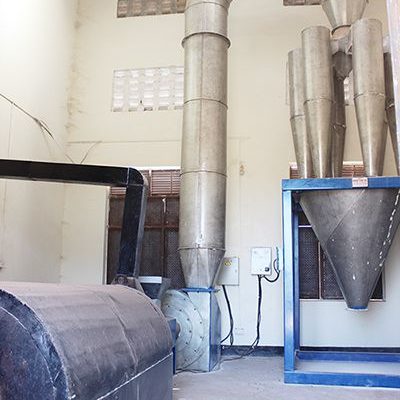
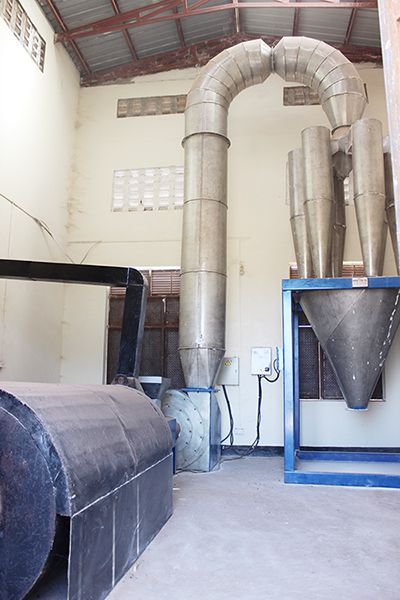
Chipped or grated cassava would take longer to dry and would be highly contaminated by extraneous materials. Introduced from Nigeria in 2016, the flash dryer, a high precision indoor modern cassava drying technology, came at an opportune time.
The technology, makes processing independent of weather, so processors can dry their cassava throughout the year irrespective of weather. This sent many processors smiling after an upgrade from open air processing to the new technology that offers the best answer to weather challenges especially during the wet seasons.
The flash dryer is a state of the art machine designed to dry wet cassava mash, extracted from the cassava graters, into High Quality Cassava Flour (HQCF) within 3 seconds, making it ready for human and commercial use. The flash dryer can process 3 to 7 tons of HQCF per day.
This technology was introduced by the CAVA project in 2016. Two potential investors from Northern Uganda; Wind Wood Millers Limited in Lira municipality and Adyaka Wholesalers Limited in Apac district picked interest in the multi-million-dollar investment after partaking in a study trip to Malawi to witness the machine at work.
They were amazed at the entire process and decided to come back home and adopt the technology after realizing the benefits including the potential to create employment for more than 2,000 smallholder farmers working as out growers supplying fresh cassava roots to the factories.
Mr. Ivan Okori, Managing Director, WindWood Millers Ltd
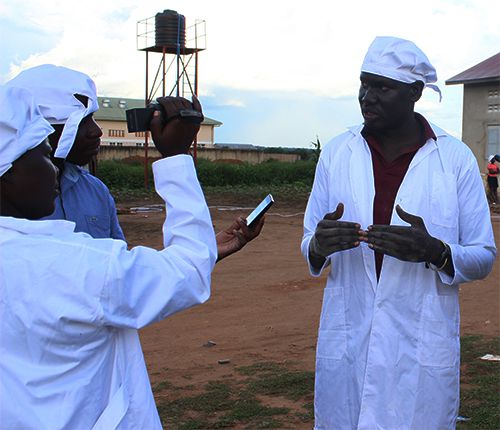
Ivan Okori, the Director, Windwood Millers Limited Cassava factory speaks to local Tv and radio press on the profitability of the flash drying technology and the benefits of the technology to the communities in Lira district and beyond.
Ivan Okori, 32 years, is a young shrewd down to earth business man from Kole district, Northern Uganda. He is the Managing Director of Windwood Millers Limited (WML) cassava factory. Ivan has been in the cassava business for close to 10 years. However, his journey with cassava begun way back because for as long as he can remember, cassava has been a very big part of his life.
“I grew up seeing cassava, surviving off it and understanding the potential of what it offered meant for my community and region”
“If every member of the community owns at least an acre of cassava and earns about 1000 USD per season, it would mean a lot for the development of the community. Children would be able to attain a good education, there would be food security and improved nutrition due to the proceeds and also the fact that cassava has the necessary shock-proofing compared to other crops that are susceptible to drought.” says Ivan.
The story of Wind Wood Millers Ltd cassava factory
Wind Wood Millers Limited was incorporated on August 2011 in Lira district, Northern Uganda. Initially, the company dealt with rice production until 2013 when it embraced cassava. During this time, CAVA had already engaged with the company and extended the project outreach programmes to develop the factory to venture into High Quality Cassava Flour (HQCF) processing.
“By this time, I had seen the potential of cassava growing so fast, and I was among the first people that worked with Uganda breweries limited (UBL), a beer company that needed cassava to brew their popular Ngule and Senator beer brands. So, I started aggregating and sourcing for them this raw material. CAVA had been aware of our push towards cassava and were interested in finding flexible businesses that had high potential for growth as SMEs in areas the project targeted. And from that we had initial contact and engaged in discussions to jointly tread the journey.
And so, we walked with them through the journey of working with farmer groups, having these tested, analyzing them and meeting the potential markets. We have been with them through the whole journey to this day of us having the flash dryer. We worked with mainly 17 farmer groups from Eastern and Northern Uganda through the CAVA Project that reached out to farmers and extended skills in good agricultural practices, trained them in using new processing technologies and also availed these technologies to the farmers, especially the use of raised metallic drying technologies to obtain a quality product ready for the market.
These farmers were trained to hygienically handle and dry the cassava at the right time so that its potential qualities like the starch remain intact. CAVA set a precedent away from the traditional ways/ methods of placing it directly on the floor which highly compromised quality and these interventions greatly revamped the cassava value chain.
My work as an aggregator was made easy. I sourced for quality chips from the farmers who were by this time organized into farmer groups. After I got the chips from the farmers, I milled this into flour and supplied to the brewery but also the local markets especially the composite flour millers and bakeries. The product was to the standards expected by the markets- very good quality.” Ivan adds that since the interventions, the crops potential has widened. “Today, cassava price has doubled more to what it was that time.
In some uses, it has twice doubled and I think the potential is even greater if we follow through what other countries are doing with it, for example, Thailand and other western countries that have maximally used cassava way down to glue making, glucose /fructose production, and other industrial applications. Every month am surprised by what comes up. I have seen that cassava can do paperboard and so far, the trials to apply it have been quite successful and that is a market we are working to tap into.
I have also recently got to learn that cassava can be used to make a certain type of cement. This is amazing. And, with all these developments, I see cassava as a crop of the future and am also glad that Wind Wood Millers is at the fore front of pushing to ensure that the cassava future is bright not just for us or the communities we work for but also beyond.” remarks a smiling Ivan.
Ivan says that the factory is located in the area because it is known to be a cassava basin and this favors its presence there.

Mr. Okori, the Director, Windwood Millers Limited Cassava factory (left) and employees, process fresh cassava root into High Quality Cassava Flour (HQCF) using the flash drying technology.
His journey to acquiring the technology
In 2015, Ivan was selected and facilitated by the CAVA project to visit Malawi to experience and witness first-hand the flash drying technology. And just like Mr. Sam Opio of Adyaka Whole Salers cassava factory, he too acquired the investment that CAVA supported him to obtain. Today, he and Opio are the only two investors of the now fully operational cassava factories in Lira and Apac districts, in Northern Uganda.
He passionately speaks of how he was inspired to take on the investment. “When in Malawi, I had quite some interesting experiences from which I learnt a lot. I interacted with a young gentleman not more than 4 years older than me who had a 400acre cassava farm.
I had never in my life seen so much cassava, funny, because you would think growing up seeing cassava gardens all around me, I had seen all the cassava there needs to be seen, but NO! apparently, I had not. This, to me was an interesting challenge and was the initial spark / drive to scale up my gardens.
Then I saw the cassava factory in operation and was quite amazed at how the HQCF was produced in just seconds, and the same product was being used to make biscuits. This also blew me away.
I really liked the consistency with which they were able to buy/use fresh cassava root, process it, dry it, pack it and take it to the production site of the biscuit company and produce an end product ready for the market.
This all got me seriously thinking, ‘if they could do it, so can I’. And when I returned, my mind was already sold into it all. And the reason I was quick to take up this technology was due to the consistency in production quantity and quality of the end product.” says a cheery Ivan.
Challenges with acquisition of the Flash dryer
Ivan narrates the struggles he endured with acquiring the multi-million-dollar investment.
“This was quite a tough journey. First of all, the model was from Nigeria and so had to be shipped here. Also, all through the process, we were very much convinced that the agro processing machinery was tax exempt and so, our financial base at the time the dryer was coming in was mainly focused on just setting up the factory housing structure based on the designs availed by the NOBEX Technologies engineering team from Nigeria.
But, when the machinery came, we were shocked to discover it was not tax exempt. This was a blow that cost us about 17,000USD. It was a tough battle that took about 6 months and we lost quite some money in it. Tuning the machines took a very long time of close to about 2 years and the greatest challenge post installation has been the cost of fuel to run the machinery.”
He also mentions that to address this, there are approaches being applied by the company to tackle the fuel challenges. “We first of all are working to retune the machines to use less fuel. We conducted a market study for the different clients, understood what they require and are giving them exactly that. We segmented our product lines and are creating different variety products of very high grade, middle and more affordable grades.
All these efforts are so that we cut fuel consumption by over 50%.” The factory is currently producing different grades of quality flour to satisfy the different target markets.
Ivan feels there is a huge lesson to learn from the entire experience. “The lesson around this is that if we were to do it again, we would be best prepared on how to handle this especially seeking prior exemption before the machines are on their destination from the original countries.”
Challenges in the flash drying business thus far
He narrates the challenges in the business. “Sometimes there is scarcity of cassava root and this causes a hike in buying price. We are also not yet certified which is keeping us out of penetrating the international markets, and these are many because they have a high utilization capacity for the cassava flour since it is gluten free.” Ivan also mentions that they are still faced with challenges in marketing the HQCF product because there is still little knowledge on its potential use and application in different industries.
He also points out that there is still need to replicate the model to a more affordable and less man power intensive enterprise. “Given that there are different stages in the flash drying process, this somewhat slows down the drying process and we feel that we are not utilizing it to its fullest capacity. Along the way, there is peeling and we currently use peelers but the job is still not a hundred percent. This can greatly affect the end product. Aside from that, the cassava needed is a lot and the processes are tedious, because there is peeling, washing, pressing, and to be honest, if these were automated, it would save us a lot more money.”
Benefits of the technology
Ivan, despite the struggles, confesses that the investment is one of the best decisions he has made in life for he sees a bright future ahead. “The market for HQCF is quite big and we are tirelessly working hard to hit this market. The companies I supply to are very impressed with my HQCF and I look forward to a long working relationship with these because they have appreciated how using local raw material like cassava flour has greatly contributed to cutting down on their costs of production. For example, they attest that the product has impacted on their industry targets because they save about 400 UGX per kilogram purchased. These save between 5000 to 8000 USD monthly by buying our flour.”
He further notes that the investment has enabled them create high level products that are able to meet the different industry demands with quality and consistency. This has informed the company to come up with the right price for the different target industries. “By using the technology, we are able to measure improvements in productivity, thus enabling us save time and costs. There is a huge efficiency saving in using the dryer and it’s a whole different production process which is less tedious than having to depend on weather. With this, we are assured of a consistent quality product that leaves a client happy and satisfied.”
He also attests that the investment has landed him more partnerships and elevated his stature as an SME in the Lango sub region. “We have secured more markets stretching to as far as South Sudan due to a strong network created over the years. WML has a pool of farmers that have reached out to us for planting material and this offers a basic drive to develop our communities. We also have a pool of companies, NGOs, Government initiatives that want to promote cassava and look at us as the best example to promote cassava because of what and how we’re doing it.”
“We are tapping into all these markets that are readily available to consume all this cassava flour. CAVA has helped us establish the profitability of the machine and linked us to all these markets that we have to keep happy by ensuring timely provision of the product.” We have to maximize our opportunities using the Flash dryer. It is seasonal. Come rain or shine, it runs. Out-growers are awed by the technology and amazed by the fact that it dries cassava within seconds rather than what they are used to of hours and hours, days, and sometimes weeks of drying.
Innovations fostering the business / operations
Ivan states that the company is benefitting from other partner programmes secured by new partnerships formed. He attributes this exposure to linkages created by CAVA. “We have a partnership with GOAL Uganda and this has broadened our reach to other districts like Agago.
We also have a partnership with the Ministry of Science, Technology and Innovation that has given us a grant. This has enabled us acquire a new technology like the automated press and is supporting us to secure certification from UNBS. We also have a partnership in progress with GIZ. All these, we believe are avenues that are pushing us further and further to achieve our goal.”
Ivan also mentions that the factory has embraced use of ICTs to digitize the relevant information needed to boost business. “We are in the era of technology and we realize that to be successful, we have to move in that line. And so, we formed a partnership with ThinVoid, an IT company that is helping us design a farmer identification App to enable us track the duration of farmer gardens, and monitor them up to harvest.
Through new innovations, we are pushing to have as many farmers as we can. The target is 10,000 but we are currently working with 1000 that have been contracted to supply FCR to sustain factory operations on a daily basis”
Ivan is one of the youth highly recognized in cassava production and processing in Northern Uganda and has ventured into programs to support fellow youth to access clean planting material at a subsidized fee in order to sustain production for not only the factory but also ensure these have an assured income and food at home. He is a champion of the youth in agribusiness initiative that has seen 4,710 youth in the region, benefit in the cassava business.
“All these efforts are geared towards ensuring consistency in root supply. The Flash Dryer is sky rocketing processing of fresh cassava tubers into HQCF. It guarantees constant processing of fresh tubers into quality flour, irrespective of the weather burdens. We no longer rely on sunshine to guarantee output,” says Ivan.
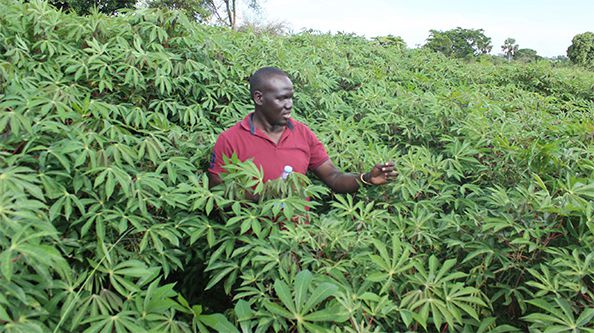
Mr. Okori in his quality cassava garden from which farmers in the region have readily accessed the material for multiplication so as to sustain fresh root supply to the factory.
Okori endorses investment in the technology
As a pioneer in the flash drying technology, Ivan encourages more investors to acquire the technology.
“It’s been a long journey. We have travelled it with tears, smiles and uncertainty along the way but here we were, standing strong amidst it all. If we did it, you too can do it, so yes, get the machine. We have set the pace and there are many lessons you can learn from our experiences, and we are readily available for any inquiries. Do a lot of market research, be creative and also be very patient with this investment. It is a long-term plan that comes with a lot of patience.
I highly recommend the technology to other processors. However, I advise that due to raw material concerns, they should be at arrange of about 150km from one another.
I also encourage fellow SMEs and farmers to plant more cassava because we are ready to consume it, work with them, ready to train them on the production and processing innovations and share our thoughts about cassava and create a market for it. Work with them and the future of cassava to our community.”



Leave a Comment